Muhammad Ali: Why He Should Be Remembered

An icon passed away.

A boxer.  A three-time heavyweight champion. A poet.  A comedian. A political activist.  A humanitarian.

Muhammad Ali.

Disclaimer: I’m not a fan of boxing.  I’ve never understood the appeal of watching two men attempt to beat each other to a pulp.  Outside the ring, they would be arrested for the same thing. (Although I am a fan of boxing movies. Raging Bull, Rocky, and Requiem for a Heavyweight depict the brutality of the sport in beautiful images.)  However, Muhammad Ali’s powerful and beautiful body was paired with an equally powerful and beautiful mind, and had he not been born into a poor Southern black family in the early 1940s, he quite possibly would not have felt the need to turn to a brutish sport.

Here are my reasons for admiring Ali.

Ali the Entertainer


Muhammad Ali Screaming

“My way of joking is to tell the truth,” Ali once said.  “That’s the funniest joke in the world.”  And he was right.  Ali  would use humour in a bogus attempt to appear overly confident (he was confident, regardless).  In 1962, when he was just 20, Ali had a press conference in the locker room moments before his fight with Archie Moore, the man who for a time had been Ali’s trainer.  “Moore in Four Next Champ,” Ali had written on the chalk board.  He then screamed at the board to make sure reporters got the point.

Ali would use humour in a bogus attempt to appear overly confident (he was confident, regardless).

Ali always referred to his talent in his ring as a source of humour.  “I am the greatest.  I said that even before I knew I was.”  Or there was the time he said, “If you even dream of beating me, you’d better wake up and apologize.”

I suspect that Ali viewed himself as an entertainer.  Take a look at the press conference with Frazier shortly before their fight in Manila.  Ali laughs at his own jokes, even as he’s taunting Frazier.  Clearly, were Ali a 20-year-old boxer today, he’d no doubt be promoting himself on social media.  After all, Ali always had a spotlight on media, saying that Hollywood made Rocky to counteract Ali as a great black boxer.  “America has to have its white images, no matter where it gets them.  Jesus, Wonder Woman, Tarzan, and Rocky.”

Ali the Political Idealist

In 1964, Ali won the heavyweight title for the first time and converted to Islam, giving up his given name, saying, “Cassius Clay is a name that white people gave to my slave master.  Now that I am free, that I don’t belong anymore to anyone, I gave back their white name.  And I chose a beautiful African one.”  So in 1966, when the U.S. government decided to draft Ali, perhaps hoping to send him to Vietnam, Ali refused, citing his conscience.  “Why should they ask me to put on a uniform and go ten thousand miles and drop bombs and bullets on brown people in Vietnam, while so-called Negro people in Louisville are treated like dogs and denied their civil rights?”  He famously asked out loud “Shoot them for what?  They never called me nigger.  They never lynched me.  They never put no dogs on me…raped and killed my mother and father…” (click here to see the interview.)

Muhammad-Ali-vs-Sonny-Liston

His fight with the government proved to be his toughest.  And it cost him not only legally but also financially and professionally.  He spent four years in the legal system, having been convicted for avoiding the draft in 1967 (the Supreme Court eventually overturned it, so Ali avoided a possible five-year prison term).  Yet that wasn’t the most taxing cost.  No boxing commission would let Ali fight in the United States for three years.  He couldn’t get a visa to fight outside the country.  And he was stripped of his heavyweight title.

Shoot them for what?  They never called me nigger.  They never lynched me.

Yet Ali remained busy during these years–his athletic prime–away from the ring.  As the Vietnam War became increasingly unpopular, Ali spoke at universities, even speaking before a crowd of 4,000 at Howard.  His bold public stance inspired other civil rights leaders, notably Martin Luther King and Al Sharpton, to speak their anti-war views.

Ali the Humanitarian

Muhammad-Ali-Wallpaper

Despite using his body in a brutal, violent manner to earn his fortune and fame, Ali proved that he was a compassionate human being.  Toronto Star columnist Bruce Arthur wrote about the time Ali visited a women’s prison and kissed only the unattractive women.  “The good-looking ones ain’t got no problem,” Ali is quoted as saying. “But them ugly ones, who’s gonna kiss them?  If I kiss them, they got something to talk about the rest of their lives.” (Feminist readers may cringe at the quote, but in a round-about way, Ali, despite his patriarchal overtones, was acting in an enlightened way.)

Then there was the time in 1981 when Ali famously talked a man out of suicide (see the news clip here).  Ali spent twenty minutes with him, saying, “I’m your brother, man.”

But there are stories that, and I’m unable to substantiate them, of Ali in his later years, riddled from the Parkinson’s that he likely developed from years in the ring, opening his door to people passing his house in hopes of a glimpse.  Some even had dinner or watched tv with him.  I like to think these stories are true.

Ali at the End

Everybody’s life comes to an end.  When we’re young, we’re beautiful, strong, and out to conquer the world.  Ali certainly had all three traits.  I could easily post a picture of Ali in his later years, when age and Parkinson’s robbed him of his looks and voice.  But I’d rather remember the young Ali, the strong Ali, the principled Ali.  He may have chosen a sport I abhor, but he made a difference.  In his own way, he changed the world.


A Tribute to Garry Shandling — Adam Sidsworth Toronto Editor Writer

The past week’s Toronto headlines have been dominated by the death of a former crack-addicted mayor who, in death, deserves at best sympathy and definitely not praise. So it may come as a surprise to many that last Thursday legendary comedian and comedy writer Garry Shandling died, reportedly from a heart attack. He was 66. Perhaps most famous for his 90s comedy series The […]

via A Tribute to Garry Shandling — Adam Sidsworth Toronto Editor Writer

Christmas Specials

It’s December and despite the fact that stores hang their Christmas decorations on the day after Hallowe’en, we can finally talk about the holiday season.

Let’s face it: Christmas belongs to kids.  As we get older and the responsibilities of life leave you feeling blue and mundane, you probably realize that your Yuletide memories are in your childhood.  Maybe your fondest memories include:

  • Decorating the Christmas trees, and all those Christmas presents under it;
  • Singing Christmas carols in the gym in grade school;
  • Going to high school the day before Christmas holidays, knowing that half the kids will skip anyway (or did you skip);
  • Toboganning, skiing, or snow fights during the two-week Christmas break; or
  • Opening presents Christmas morning

But don’t forget the fondest of holiday memories, the Christmas tv specials.  Long before Netflix and the internet, you’d have to watch the specials when they were scheduled on tv, adding to the specialness of the experience.  The tv station would play the promos a week in advance, so you’d spend the week in anticipation.  When it finally aired, you’d cram in the tv room, everybody fighting for a spot on the couch.  Here’s a compilation of the best tv specials and movies that play every year.

A CHARLIE BROWN CHRISTMAS

charlie

Naturally, this comes at the top of the list.  Celebrating its fiftieth anniversary this year, A Charlie Brown Christmas is a rallying cry against the commercialization of the holiday season, even though it was initially sponsored by the Coca Cola Company.  The animated special is an exercise in narrative restraint: it has a 25-minute running length, focuses on a tightly told narrative arc, and has a clear-cut moralistic message.

Charlie Brown is depressed: His sister asks Santa for money, his dog enters a tree-decorating contest for a prize, and kids don’t understand Christmas.  When his antagonist friend Lucy invites him to direct the Nativity play, he’s initially excited but becomes frustrated when can’t find the right spirit.  He chooses a sad-looking Christmas tree to decorate the stage, and the kids mock him.  After Linus cites a biblical quotation about Jesus’ birth, Charlie leaves, and the kids fix up his tree, finding Christmas spirit while singing “Hark the Herald Angels.”

Yet it’s the uneven quality of the production that creates the amazing atmosphere, including the poor animation and clipped dialogue of the untrained kid actors (some were too young to read, so they had to repeat lines spoken to them, hence the choppiness).  But the icing on the cake is Vince Guaraldi’s jazz-infused score.  Nobody had ever used jazz of that quality for a kids’ show, and it had the effect of treating the kids as intelligent.

Dr. Seuss’ How the Grinch Stole Christmas

how-the-grinch-stole-christmas-christmas-movies-17366305-1067-800__140115233531

I’ll never forgive the people who thought it would be a good idea to turn this beloved Dr. Seuss tale into a feature-length Jim Carey movie, because like A Charlie Brown Christmas, Dr Seuss’ How the Grinch Stole Christmas‘s shortness–26 minutes–is a great thing.

Based on Dr. Seuss’ children’s story, the titular character, whose heart is “two sizes too small,” detests his neighbours, the Whos of Whoville.  He lives alone, apart from his loyal dog, Max, whom he uses in his diabolical scheme to end Christmas.  Christmas, it seems, is when he is most miserable, because the kids will “…rush for their toys, and the noise, noise, noise!” and “Roast beef is a feast I can’t stand in the least!”  Dressing up as Santa Claus, he travels to Whoville to steal all the presents and decorations, in hopes of stopping Christmas.  Sleighing back to his home on Mt. Crumpit, he hears the Whos come out and sing Christmas carols, causing his heart “…to grow three sizes that day.”  He returns to Whoville, rejoices with the Whos, and “He, the Grinch, served the roast beast himself.”

Apart from the amazing quotes, which come directly from the Dr. Seuss book, a lot of elements work well for this masterpiece, including the choice of Boris Karloff as narrator and the Grinch’s voice.  Karloff, perhaps most famous for playing Universal’s Frankenstein’s Monster in the ’30s, was in his 70s when he voiced the Grinch.  His rich baritone voice and English accent created the right atmosphere.  But most importantly, the songs were memorable, especially “You’re a Mean One, Mr. Grinch,” sung by Thuri Ravenscroft (the voice of Tony the Tiger).  Who doesn’t sing it every Christmas?

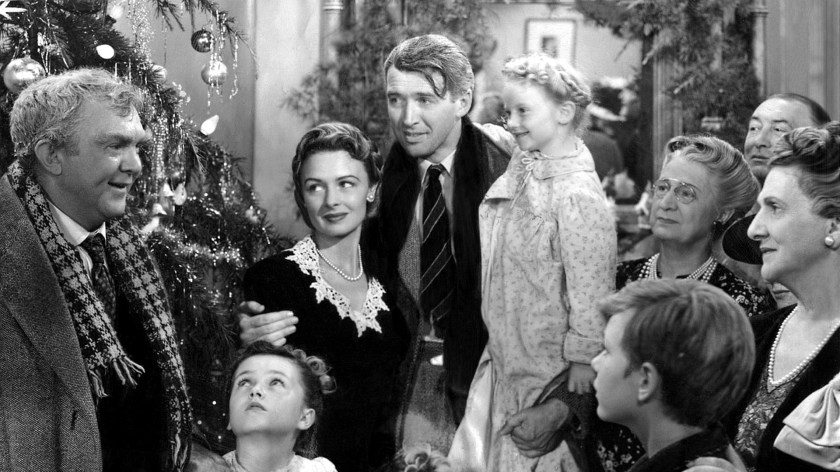
It’s a Wonderful Life

its-a-wonderful-life-3

Many people argue that It’s a Wonderful Life isn’t a Christmas movie, since so little of the movie’s running time is set during Christmas.  Yet try watching the movie in July.  Exactly.  It wouldn’t be the same thing.

The movie’s plot needs no introduction: Clarence, a dim-witted angel, must save the life of hapless George Bailey, who’s contemplating suicide on Christmas Eve.  Clarence watches George’s life: as a kid, George saves his younger brother from drowning; as an adolescent he prevents drunk pharmacist Mr. Gower from putting poison in a kid’s prescription; as an adult he takes over his father’s building and loan business.  George sacrifices his ambitions of college and word travel, but he builds new homes for people, helping them escape the slums of Mr. Potter.  But when $8 000 goes missing from the business, George, fearing arrest, becomes suicidal.  Clarence intervenes by showing George how much poorer people would be if George never existed.  With a new resolve for life, George rushes back to his family, only to find the town congregated in his living room, having raised the missing money.  George’s war-hero brother, who fought through a blizzard to get home, raises a toast: “To my big brother, George, the richest man in town!” A bell rings–Clarence earned his wings–and everybody sings “Auld Lang Syne.”

Sure, the movie’s end is complete syrupy cornball, but very few people can resist that last scene.  It’s a Wonderful Life actually lost money on its initial release, eventually causing director/producer Frank Capra to close his production company. The producers let the movie’s copyright lapse, allowing the movie to endlessly play on PBS, where audiences rediscovered it.  Some interesting trivia about It’s a Wonderful Life: the scene where George Bailey runs through the snow was actually shot during a summer heat wave; of the two surviving sets, the underground pool that George and Mary fall into during the dance is still in operation at a Beverly Hills high school and is currently under renovations; and Jim Henson claimed in interviews that it was a coincidence that his roommate Muppets, Bert and Ernie, shared the first names with the movie’s cop and cab driver friends.  But beyond the trivia, the nearly seventy-year-old classic remains a holiday classic because of its simple, endearing message; its dark atmosphere; and sentimental ending.  But fans of It’s a Wonderful Life should watch Meet John Doe, a much darker Frank Capra movie in which a hobo attempts suicide on Christmas Eve.

Scrooge

scrooge-1951-1

Filmmakers love Charles Dickens because he’s out of copyright, so it’s no surprise that his most-famous holiday story, A Christmas Carol, has been adapted on both the large and small screen countless times.  It’s a great source and an atmospheric story, but the dozens of adaptations are a mixed baggage: some are all right, some are forgettable, some star Muppets, and some are creepy (sorry, but the digitally animated Jim Carrey version IS disturbing).  But only one adaptation is stellar: the 1951 version, starring Alastair Sim.  Sim’s portrayal of Ebenezer Scrooge is so career defining that many people may not realize that Sim’s acting career spanned forty-five years and fifty movies (check out his Ealing comedies).

The story, you know: Ebenezer Scrooge is a loner, a miser, and a misanthrope who despises the Christmas season, viewing it as a needless distraction from making money and earning a living.  Scrooge–and this is what most people miss–is a pained soul who would rather avoid human contact than be hurt again.  He abuses his sole employee, refuses to donate to charity, and failed to mourn his one true friend’s (and business partner) death.  When that one true friend, Jacob Marley, appears to Scrooge in the form of a spirit and offers a chance to save Scrooge’s already-damned soul, Scrooge is taken on a journey by the Spirits of Christmas Past, Present, and Future.  We see the impact of both Scrooge’s childhood on Scrooge and Scrooge’s impact on other people, notably his employee, Bob Cratchit, and his nephew.  By Christmas morning, Scrooge sees the value of connecting with people, helps the sick child Tiny Tim, and joins his nephew for Christmas dinner.

It’s a touching and moving story, but the movie stands out for many reasons, not the least of which is the acting, particularly Alastair Sim in the leading role.  Sim had a naturally expressionistic face and looked far older than he was (he was 51 when the movie was released).  His theatre background gave him great facial expressions (every actor portraying Scrooge since Sim merely mimics him).  But Sim was joined by great company.  Who can forget Michael Hordern as Jacob Marley’s ghost?  The scene in which he visits Scrooge is eerily chilly: he sits on the seat next to Scrooge and screams that haunting scream.  “Mankind!  Mankind was my business!”  Or when he opens Scrooge’s window and appears on the cold, snowy ground outside with dozens of other spirits in chains as they attempt to save a homeless woman and her starving children.  The black-and-white cinematography is haunting, spooky, and scary, and adds to the moralistic lesson of Scrooge. 

Why I Got on the Blue Jays Band Wagon

jose_bautista_bat_flip

For me, this past October will go down as the year that I got on the band wagon and started caring about the Jays. On the day of the Jays’ Game 5 against the Texas Rangers–you know the game I’m talking about–I worked until 5:30 in the afternoon. After work, I took the subway to the Rogers Centre (should I say Sky Dome?) During games, the Rogers Centre plays the radio feed outside the dome. I walked to Gate 8, where people had gathered. On the other side of the doors, a large tv was broadcasting Fox’s coverage of the game. Twenty people stood outside those doors and watched. When you looked inside, you could see people sitting on the 100 level. It was almost like being inside.

I’m not normally a sports spectator and I don’t play–I’m missing the part of the brain that’s responsible for eye-hand coordination. The thought of watching sports on tv bores me (how is watching golf or NASCAR on tv entertaining?), and I can’t justify spending money on going to a game. But this year I got caught up in Blue Jays play-off fever. It’s not that I thought they were going to win it all, seeing that it was their first year in the play offs in 22 years; last time it took them a few tries to win it all. Plus they played the last few games of the regular season atrociously. Yet when they won the AL East, I got excited.

It wasn’t the Blue Jays success that got me. After all, I’m not playing for the Jays, so the accomplishment wouldn’t be mine. Nor would it have been the City of Toronto’s accomplishment: to my knowledge, not one current Blue Jay is from Toronto. Or from Canada, for that matter.

I got on the band wagon because I became nostalgic. When the Blue Jays won their back-to-back World Series in the early 90s, I was a high school kid who really enjoyed watching baseball. And to top it off, during the same time my uncle asked me to help him coach my brother’s baseball team, despite the fact that I couldn’t play and stuck out like a sore thumb when I tried. But it was good for me (I got in shape and had two great of summers). And I thought it was amazing to be from a city of sports greats–even the Leafs were playing well at the time.

But time got in the way. In 1994, the Expos (remember them?) were going to win it all, but the strike cancelled the season. I hated that MLB added inter-league play (the NL used to be a mysterious league where pitchers went to bat). And the post-season keeps expanding (what’s the point? The regular season is 162 games).

Yet this year I got on the band wagon because my memories of what it felt like to be 16. In 1992, I was in grade eleven in Mississauga, and on the day of the parade, the school virtually shut down. A friend and I stood outside the school as a classmate of ours got in her boyfriend’s car to join the parade downtown. It was an overcast, cold fall day, and we’re shaking outside. I ended up watching the parade on tv with my science teacher. I remember it like it was yesterday.

So here I am, 23 years later, walking up to Gate 8 of the Rogers Centre. It’s an overcast, grey day. I arrive just in time for the wonky seventh inning, when, for twenty minutes, the umpires deliberated the Rangers’ weird run. I talk to the kid next to me and we debate the meaning of John Gibbons’s body language. “No,” I said to the kid. “The run stays.” When Bautista scored his game-winning home run during the bottom of the seventh, everybody cheered, including me. When the teams nearly charged each other, my shoulders sunk in disappointment. Was a good, albeit bizarre game, going to be ruined by ejection and fighting?

I looked around at the twenty people gathered outside. Some of us were older, but most were kids who were probably in diapers in ’92 and ’93. Some of them probably hadn’t even been born. And here they were, cheering, rooting, and experiencing local baseball success for the first time in their lives. Watching them, I got enjoyment watching their enjoyment.

Of course we know that for Blue Jays fans, the story didn’t end well. The Jays won’t be playing in the World Series this year. But for a few kids standing outside Gate 8, they have memories to last a lifetime.

Letterman is Gone and I Don’t Care (Kind of)

letterman kaufman

Last Wednesday David Letterman gave his final show. Having hosted two consecutive night shows on NBC and CBS for 33 years, Letterman bested Johnny Carson by three years. Letterman had announced his retirement some months before, and apparently there was a six-week build-up on his show that included big-name celebrities coming by to say their final farewells. I have to use the word “apparently” because I haven’t had cable for almost a year, so I wasn’t watching. Even when I had cable, I hadn’t watched him for fifteen years plus.

For most of the ’80s, there were two late-night talk shows: Carson and Letterman. Carson was old school, polished, and in with the celebrities, whereas Letterman threw tvs off roofs, did stupid pet tricks, and was brash and sometimes rude with celebrities. Even in the early 90s, when Carson retired and Letterman jumped networks and became late-night king, he was still contemptuous and full of spunk in the Ed Sullivan Theater.

I was a young kid in the 80s, so I missed most of his NBC show, though I did see the odd episode during the summer. Had I watched Letterman regularly, I would have been in awe of those shows: Andy Kaufman’s staged fight with wrestler Jerry Lawler, Crispin Glover’s kooky behaviour, and the black-and-white photos before and after commercial breaks. During his first year at CBS, when I was watching, I loved it: Surajul and Mujubar’s cheap Statue of Liberty novelty item on Letterman’s Christmas tree, Madonna’s vulgar-enhanced interview, Drew Barrymore’s flashing her breasts on his desk.

But his show lost touch with me, even by the late ’90s. Letterman had his heart attack and became mortal. The 9\11 attacks changed and saddened him. And in an age when cheap tv and reality shows are king, there became a proliferation of talk-show hosts interviewing the same guests over and over and doing the kind of gags Letterman invented twenty years ago.

As I write this, I’m thinking of all the shows that have been on tv way too long for their–or anybody’s–good. Some, like The Simpsons, started off good but limped into crap; others, like Survivor and American Idol, were a phenomenon for one season but were stretched into multiple junk seasons; and some, like Dancing with the Stars, were never good to begin with. And for every one good show like Breaking Bad or Boardwalk Empire, there are ten junk shows like Judge Judy and Steve Wilko. Add the proliferation of online video services and pirated tv, who pays for cable?

That’s why I didn’t watch Letterman’s finale: no cable. The CBS online service is blocked in Canada, and I don’t have the patience to find pirated sites. I’m sure somebody’s posted it on YouTube, but at this point, I can’t be bothered. It’s too late.

When Carson’s last shows aired, I watched. I watched Bette Midler, as his last guest, serenade him. And I wasn’t even into Carson. I considered him an old guy my grandparents watched, along with Sinatra and Dean Martin. Letterman was my generation. And I didn’t watch his last show. So in a way, I’m sad. For me, tv is dead.

Sam and Marlon

Hot Docs is an annual ten-day festival devoted to feature-length documentary movies. This year I had complimentary passes and saw two movies that shared a haunting theme: two hoarders who, through their egos and sense of self-importance, recorded themselves for prosperity.  As similar as these two people are, their lives took very different trajectories.

Sam Klemke’s Time Machine, features Sam, who in 1979 at age 19 begins to obsessively film key events in his life, including his annual summary of events. Sam, a travelling caricature artist by profession, relates his ups and (mainly) downs.  He doesn’t have an easy time in life: Over the years he becomes profusely obese, has difficulty keeping jobs and making money, is constantly moving in and out of his parents’ house, and has difficulty relating with women.

Sam began his video diary the same year that NASA launched Voyageur, a space capsule that not only explores the planets of the solar system but also contains relics of human life should it encounter extra-terrestrial life.  It has a map to Earth, pictures of people, and a gold-encased vinyl album containing human voices and music.  In the movie, Sam’s videos are broken up by a documentary of Voyageur (in French!) that is as tedious as any documentary you had to watch in school.

As Voyageur transmits pictures of Jupiter and the outer galaxy to Earth, Sam recounts his life in these video diaries.  He dreams of being big-time movie maker, at one point landing a job at a local station as a tv host (it doesn’t seem to have lasted long), but Sam wails into the camera year after year that he’s getting fatter (he tips the scales at 300 lbs) and he’s unable to keep a job.  His fall back is as a caricature artist at shopping malls, drawing people’s faces for a few bucks.  He lives out of his car, pees in a cup, and lives like a slob.

But is success any better?

Listen to Me Marlon is equally fascinating. Director Stevan Riley, who also edited the documentary, had unprecedented access to famed actor Marlon Brando’s estate.  Marlon, like Sam, was obsessed with recording himself. Only he used audio tapes.  And he had his face digitally recorded shortly before death.  Riley edited Marlon’s recordings, which include recollections of his early life and career, with interviews Marlon had done throughout his career. The movie is book-ended by the sensationalist 1991 trial of Marlon’s son Christian, who was charged with the murder of the boyfriend of his sister Cheyenne. As an aside, I remember the media coverage of the trial; I was in either grade nine or ten, and although at the time I had no idea who Marlon Brando was (I wouldn’t see The Godfather until grade 11), I remember seeing the news clip of Marlon sobbing while testifying on his son’s behalf.

In the early 1940s, Brando attended the New School and studied acting with Stella Adler, and after some summer-stock roles, he created the role of Stanley in the stage production of A Streetcar Named Desire at the tender age of 23. By the age of 27, he stared in its screen version (only his second movie) and became an overnight sensation. In the next couple of years, he followed that up with two more classic movies, On The Waterfront and The Wild Ones.  A sex symbol who became famous for revolutionizing movie acting, success came easily to Marlon. And it came at a cost.

Marlon was an introvert and loner who turned to acting to hide.  Yet by hiding in plain site, he had to constantly dodge publicity while fleeing from it.  During his early success, Marlon uses his fame to his advantage: “I was good looking,” Marlon says on tape, “and I was going to use it”; 1950s tv clips show Marlon unapologetically flirting with attractive female reporters who coyly and shyly flirted back.  Yet Marlon wasn’t happy.  Marlon explained that his mother had run away when he was young and his father was a tyrant; a tv clip from the same era showed Marlon and his father during an interview and when Marlon’s father is asked if he’s proud of his son, he says “I’m proud of him as a man but not as an actor”; Marlon smiles and slaps his dad’s knee.  Marlon looked hurt, but on tape he says he and his dad always joked around.

For all his good points–fighting on behalf of the civil rights movements in the 60s and Native American rights in the 70s (plenty of clips are shown)–Marlon became frustrated by his early success and stint of bomb movies in the 60s, and we see Marlon on one film set rolling his eyes as he’s hoisted on a crane.  After he did Mutiny on the Bounty, Marlon becomes obsessed with escaping to Tahiti, where he buys a house.

Marlon’s fast track to success stinted his approach to work, an ethic that he seems to have shared with Sam.  Sam was never able to keep a job long and we see him lose girlfriend after girlfriend because he resorts to travelling to malls to draw shoppers (one girlfriend “never stopped nagging me.”)  Marlon, even after his resurgence in the 70s (The Godfather, Last Tango in Paris, Apocalypse Now) became a nightmare to work with. “I see movies as something I have to do three months per year to make easy money,” Marlon said on tape.  We see stock footage of Marlon reading his lines on cue cards on the set of Superman, and Marlon arrived on Francis Ford Coppola’s set having rewritten the director/screenwriter’s script because it “was a mistake.”

As I write this, I realize that Marlon isn’t as iconic as he should be and Sam isn’t all that bad.  Sam is an easy scapegoat: He never made a lot of money, never had a career, isn’t physically attractive, and has eccentric habits (peeing in a cup in a car, anybody?)  And did Marlon really deserve the easily obtained adulation? For if you take away Marlon’s acting ability, his charisma, and his good looks, (which he did lose later in life), who are you left with?  You’re left with Sam.

People talk about how easily obtainable fame is today, because YouTube and social media supposedly make it more accessible.  It’s an argument that I don’t buy; millions of people are on the internet, and sure, Justin Bieber may have started on YouTube, but he’s one in a billion.  The internet’s littered with cat pictures, and none of them are famous.  Marlon is famous, and Sam is not.  Fame is random, bizarre, and ultimately meaningless.

In his movie, Sam looks directly into the camera and says he never had kids because he never really wanted them and it “just kinda didn’t happen.”  When I watched this scene, I had internalized, socialized bigotry.  “You never had kids,” I thought, “because you’re a fat slob with no job.”  Yet Marlon had kids, and in his movie, Marlon stated he feared becoming the kind of “tyrant” father his dad was.  Marlon, with his good looks, career, and fame, came into fatherhood easily.  But after his son Christian’s conviction and sentencing and daughter Cheyenne’s suicide shortly thereafter, it would be fair to say that Marlon did not endure parenthood easily.

I now realize that I should never admire or hold disdain for Sam and Marlon, I shouldn’t worship or or curse, and I shouldn’t prefer one over the other.  Yet I had that initial negative reaction towards Sam.  And it probably says more about me than Sam.

Two or Three Things I Know About Male Art Modelling

coffee

All I’m Doing Is Looking for Reasons to Live Happily

September 2014.  I was working a dead-end retail job that neither made me happy nor paid the bills.  So I went back to school as a mature student, hoping to develop a freelance writing and editing career.  It was an excellent long-term goal, but, unfortunately, I needed a more immediate financial solution.  So I made a decision that few guys in monetary peril would make: I would male model for art classes.

It wasn’t a thought process that came out of nowhere.  A few years before, I had met a woman–an extremely fit dancer with every reason to be proud of her body–who told me she modelled for art classes.  She wasn’t ashamed of her body, she had explained to me.  And taking her clothes off in front of others was never a big deal to her.  Remembering her, I realized that I too didn’t consider taking clothes off in front of strangers a big deal.  So why don’t I do it and get some spending money?

So I contacted all the universities and colleges in Toronto that offered art classes.  I created a modelling resume, complete with a head shot (a selfie, actually) and phony past modelling jobs, and two days later, one school–my alma mater–called me back.  They needed a male model.  I felt confident.  I felt happy.  They chose me!

Words Never Say What I’m Really Saying

They initially scheduled me for one class, a portrait class, meaning that because the students would be drawing only my head, and possibly my torso, I would be wearing my clothes.  I accepted the gig.

However,  I had no idea what I was doing.  When I arrived at the class, the instructor, a graduate student of no more than 25, explained that we would start the class with five two-minute gestures.  I got on the stage, a six-inch-tall platform, where I was completely encircled by a class of 30 students, and I did various gestures: I saluted, I frowned, I bowed my head.  I thought gestures meant acting out exaggerated facial features.  I had no idea that gestures meant short poses.  The instructor was polite enough not to laugh or say anything.  It turned out that the job was more complicated than I had anticipated, and I had a sharp learning curve.  The remainder of the class went without a hitch, and nevertheless I thought that it was a really easy way to make extra cash.

At the end of the class, the department secretary offered me three more sessions, all anatomy classes.  I heard myself saying yes, not really realizing the implications of what I had just uttered.

Time Changes Me and the Person I Love

I arrived for the first anatomy class not knowing how a model acts poses in the nude.  When I walked through the door, I discovered that the class was mostly female (I didn’t mind!) and young (it was a university class, after all).  The professor, a French Canadian, introduced himself and asked me about myself.  “I was a student in the film department,” I said.  “And now I freelance copy edit.”

The professor told me I could change my clothes in the washroom and we would begin  with a series of one-minute poses.  I stood on the platform and because the students were encircling me, I would have to rotate after each pose.  The professor announced: “OK, this is Adam, and he edits for texts, and he’ll be modelling for you for the next four hours.”  The moment was here, so I pumped myself up with thoughts: “I can do it.  Remember: I love my body.  They will too.”

In My Dreams I Used to Feel I Was Being Sucked into a Huge Hole

'David'_by_Michelangelo_JBU0001

As my bathrobe hit the floor, thirty pairs of eyes looked at me with the hot intensity of a thousand suns.  One of the young women, who looked about 17 or 18, very obviously moved her eyes to my crotch and eyed it for ten seconds, although it felt about ten minutes.

To my surprise, I began shaking.  I was actually nervous!  And it hit me: my penis was shrinking.  It turns out that nervousness has the same effect as being in cold water.  So while I’m standing there–and I’m supposed to be still–I slightly moved my legs to make my penis un-shrink.  (It didn’t really work.)

I got a ten-minute break from posing, during which the professor lectured to the students about how to draw muscles and definition.  He then let me know that he needed me to do 2 hour-long poses.  He handed me the spear he was holding in his hand and asked me to do a pose with a huge gesture.  It never crossed my mind that I would have to basically act out a role, and I realized that I was becoming self-conscious about my body in a way that I had never been before.  During my first hour-long pose, I heard the professor talking to the administrative secretary in the hallway.  “He’s fine, but I get a sense that he’s new at this.”  Obviously the class heard too, and because of my embarrassment, I felt like I was falling into a deep abyss.

Art Is the Humanizing of Forms

I thought that the class would never end.  During the breaks I would talk to the students, who would thank me for modelling.  Many said that they didn’t know how models did it, how they had the nerve.  I told the students that it was no big deal, that a body is a body, and that if I had a conventionally unattractive body, they’d still find me interesting to draw.  As I talked to the students, I calmed down.  And the most unusual experience came at the end of the class, when, after I dressed, I happened to walk behind two students in the hallway, both of whom were holding large canvasses pictured with my naked body while immersing in a large crowd of students.

art students.jpg

But I knew that my biggest challenge was allowing myself to create the large gestures that the professor wanted.  I sensed that he wanted me to choose poses that would exaggerate my body and definition.  After all, he was teaching these kids to draw the human form realistically and artfully.  I had two more modelling sessions, and they were with the same professor.  My concern was how do I, who have never acted or danced professionally, teach myself to let go?  (I eventually solved that problem by taking burlesque classes with 8 women.  If I can develop a dance routine during which I strip down to a bra and women’s panties in front of strangers, I can do anything.)

To Define Myself, One Word: Indifference

By the end of those three sessions, I was a lot more comfortable with being nude and the centre of attention of a large group of people.  I had posed for the same class each time, and I got to know them a little bit, and they got to know me.

In the two school years that I’ve been modelling, I have modelled for many types of classes: portrait classes, anatomy classes, sculpture classes.  During my modelling sessions, I’ve listened to countless student conversations: the two female students who talked to each other about how hard it is to date as a lesbian in a small town, students talking about how they were affected by the teaching assistants’ strike, or students who were struggling to juggle their work loads.  It took me back to when I was their age and the struggles I had in my 20s.

I’ve become the school’s go-to male model. I’ve gotten to know the professors and administrative staff, and I’ll probably be called back this September.  And as one student recently reminded me, I’ve posed for hundreds of drawings.  And she was right.  So if you ever happen to stumble upon a nude drawing of me, be kind.  And let me know what you think.

Poking Turd with a Stick

Before I worked retail, it bothered me if cafes would let only paying customers use the washrooms.  And it’s a hassle to be in Second Cup or Timothy’s and have to ask for a key to the washroom.  People, even if they’re not paying for anything, have a sense of entitlement.  “This place is open; of course I can use the washroom!”  But why do you have more right to use a McDonald’s washroom than your neighbour’s?  Granted, your neighbour isn’t open for business, but would you walk into your neighbour’s house unannounced and casually stroll into the washroom?

A couple of years ago, there was a debate in Toronto–it may have been brought up in city council– to force restaurants to open their washrooms to passersby. Anybody walking downtown knows there are abysmally few washrooms open to the public. This wasn’t always the case, though; a century ago the city built washroom-specific buildings elegantly designed to let people relieve themselves. Some still stand, notably at the southwest corner of Broadview and Danforth, just east of the Bloor Viaduct.

Since I’ve worked retail, I’ve gained another perspective. Allowing public access to the washrooms is a bigger pain than a constipated derriere.

I work at a government-owned liquor monopoly–those of you in Ontario know the chain. It’s not a cafe, but this monopoly prides itself on customer service. It’s on a Sunday that a man comes into the store to buy one can of beer, the cheapest thing in a liquor store. He’s in his 30s, tall and wearing track pants and a parka. “Can I use your washroom?”

The store is quiet, and I’m a nice guy. I take him to the stockroom, where the employee washroom is. “You’ve saved my life. I’ve been walking for hours and I really have to go.” I point to the washroom and stand on the other side of the stockroom and wait. Two minutes later I hear water from the sink. I never did hear the toilet flush. But I didn’t think anything of it. Maybe he didn’t do anything. As he comes out, he courteously thanks me.

At that point, I go on my scheduled fifteen-minute break. I walk outside and as my break ends, I return to make a pit stop in the washroom. I look in the toilet, and to my dismay, there is the largest piece of human turd I have ever seen. Not only that, but there’s no toilet paper in the toilet. At all. The turd is pear shaped and the size of a baseball. I flush the toilet and it won’t go down. It’s too big. I have no idea what to do.

“Guys,” I say to my fellow employees, “Don’t use the toilet.”

“We know. We saw it.” The three of us are standing at the front of the store debating what to do. Do we use toilet cleaner to make it slide down? That wouldn’t work. How about pushing it with the toilet brush? No, it would be too soft. One thing was clear: Nobody else wanted to deal with it, so it was up to me.

I go outside and find a stick. Grabbing it, I go to the washroom; I’m on all four and poking the turd. I poke it until it’s part way down the hole; I flush and it goes down. I throw the stick into two feet of snow out the back. I wash my hands.

I return to the front to a hero’s welcome. They shake my hand and I say, “Are you sure you want to touch that?” They walk away in horror.

What is the point to this humorous yet anal-derived story? The point is that cafes and restaurants operate washrooms because they’re required to by law. But using them isn’t a right. It’s a privilege. Inconsiderate, dirty people make restaurant and other business owners and employees reluctant to open up their facilities. Cleaning up after people is a dirty job, an unsavoury consequence of customer service.

And in case you’re curious, now when people ask to use the washroom, I tell a little white lie. “Our pipes are clogged.” I’m not poking turd with a stick again.

My Noisy Neighbour

I live on the seventh floor of an apartment in midtown Toronto.  It’s an alright apartment: clean, good neighbourhood, and an amazing view of downtown and the area’s canopy of trees.  But there are down points: Because the rent’s so cheap, the owners don’t put a lot of money into maintaining it.  Oh, they do what they have to, the bear minimum.  But it’s a fifty-plus-year apartment whose lobby hasn’t been decorated since the 60s (except for the framed, faded photograph of Ontario Place from the 70s), and there’s a brown-stained copy of the Landlord Tenants Act from November 1975 hanging in the mail room.  The hallways have water damage that hasn’t been repaired, and notes from the superintendent are handwritten on paper, grammar and spelling mistakes on full display.  “To who ever has one of these lockers,” one note taped inside the elevator said, “please let the superintandant know if you took one.”

The weird thing is that it took me about six months to notice any of these things.  When I moved in, I was working full time at a lucrative downtown government job (ok, not lucrative, but government does pay well), but I had been living in car-loving Mississauga and was sick of commuting in by transit everyday. I was so excited about finding a cheap apartment in midtown Toronto I didn’t look at the fine details. I liked the big balcony, the decent size of the apartment, and the price. Next time I’ll know what to look for.

So here’s my current problem: The apartment above me, a bachelor I think, has a rotating crop of people who seem to be on a time share. I know this because when I told the superintendent about a leak from above, she said “We’ll have to ask them, but we don’t know who’s there this week.” I didn’t press for details–I don’t pry about my neighbours because, to be honest, I’d rather keep to myself, but now I’m stuck wondering who they are. Are they migrant temporary workers from Mexico who come up to pick tobacco in the summer? My imagination’s going wild.

I don’t say Mexican because it’s only Mexicans who work temp work or that all temp workers are Mexican–it’s just a racist picture in my mind. But I’m pretty sure they take month-long turns sharing the apartment because one of them, a man, is so loud I can hear him talking through the ceiling. In Spanish. But why I think he’s Mexican and not Argentinian or Colombian, or even Spanish, I don’t know. Maybe I am a racist.

He has an extremely heavy gait. I know that he gets up at 7AM and I can tell by his trotting he’s out by 8AM. I don’t know why his gait is so heavy, but I suspect he’s wearing safety boots. But he must wear safety boots all day, because I hear him stomping at night too.

A couple of years ago he played his tv so loudly I could hear what he was watching. American Idol. I knew all the contestants’ names. And I don’t even have cable! I would bang my broom on his balcony until he turned down his tv. I felt like such a miser. Maybe he has hearing issues. But he shouldn’t have been playing it so loudly.

I haven’t heard the stomping for three days now, so I guess he’s moved on. He must be a nomad, living here only a month at a time. I can hear the theme songs from The Littlest Hobo and The Incredible Hulk. He’s like Bruce Banner on the highway hitching a ride, the melancholy piano music playing. The driver will probably accept him enthusiastically, until he hears how loudly he speaks and thumps his feet. And that’s when he’ll end up back here. Torturing me.

To My Dismay, I Go to Church

There is a church in a well-to-do, upper middle-class, liberal neighbourhood in Toronto that I’ve attended on Sundays.  Not to go to a sermon, mind you.  If I actually went to one, I think I’d light up in flames.  I’m no Christian, and the idea of walking into a church, even to vote on election day, makes me antsy.

But St. Clement’s Church (Anglican, I think.  I never bothered to check) has lectures on Sundays at ten that precede its sermons.  Called the Forty Minute Forum (yes, I know, there needs to be a hyphen in there), they’re open to the wider community and advertised in the local alt magazine.  And there’s no need to go to mass afterwards.  The talks are secular in topic and the guests have been varied: journalists, academics, politicians, scientists, and artists.  And there’s a chance for a Q and A session at the end.

The first talk I went to was about three years ago; CBC radio host Nora Young gave a talk about technological innovations and their effects on privacy.  I walked into the church scared people would think I was going into mass.  I followed the signs pointing to the gym and as I walked past the priests and choir singers in their religious outfits, I felt immediately ashamed of the shorts and t-shirt that I was wearing, not to mention my unshaven face and uncombed hair hidden under a hat. Although I’m no Christian, I should have taken the hat off.

As I entered the gym I noticed I’m the only person young enough to have colour in my hair. It felt like a geriatric centre. The gym had nicely polished wooden floors, the chairs are arranged into neat rows, and there was an audio display at the front hooked up to the latest technological gadgets. There’s also a table set up with drinks and cookies, where I immediately went. I then took a seat in the back row, hoping nobody would see me in the church.

A tall, lean man wearing a suit and tie and a camera strapped around his shoulders introduced himself to me. Dave is the organizer of the talks. Well spoken and youthful, he’s possibly in his 70s but seems at least ten years younger. He told me he hopes I come back. He went to the podium and introduced the speaker.

The forum has two series a year, one in January and another in April; each series has approximately five talks each. I certainly haven’t attended each lecture, but if the talk sounds interesting, I’ll go.

Yesterday I attended the lecture. The speaker, a former opera singer who’s now hosting a radio show on CBC, wasn’t a particularly interesting draw for me, but because I’ve been working every Sunday afternoon for a month at the store, I thought this would be a chance to do something interesting on a Sunday. Ben Heppner gave an entertaining talk about his career, complete with video clips of his performances.

At the end of the talk, after Dave thanked Ben for his presentation, Dave took out a statement he had prepared. “Just as the telephone book, the floppy disk, and the caboose have all come to an end, so must these forums. This is a lot of work for us to organize, and we must move on to new things. But as it is with life, I’m sure new things will come up to fill the hole.”

A delicate-looking elderly man in the audience of about two hundred stood up and started to talk, his barely audible voice shaking in tears. He starts to talk, when Dave motions to a ten-year-old boy whose job it is to take the microphone to people when they’re asking questions to take the mic to the elderly man. “I’m sure everybody would like to thank you for all the work you’ve done,” he says in tears, “But I would love it if you could continue the talks.”

“Well, shucks. Ben and I were going to do an opera duet to close the forum,” Dave responds in jest. “But we’re out of time. But as I said, life moves on, and I’m sure we’ll all find new things to do.”

I walked out of the church surprised at myself at being able to empathize with the elderly man; his Sunday church service had been cut in half. As little as I am into the church experience, I realized that a lot of people, especially elderly people, probably go to church for the social aspect. It gets them out of the house. Although I went to the odd Forty Minute Forum simply to listen to interesting people, I too felt a bit of a void in my life.  I too felt proud of these forums.  And now I won’t be going to church on Sundays.  How odd that I’m writing this.  I never saw this coming.